
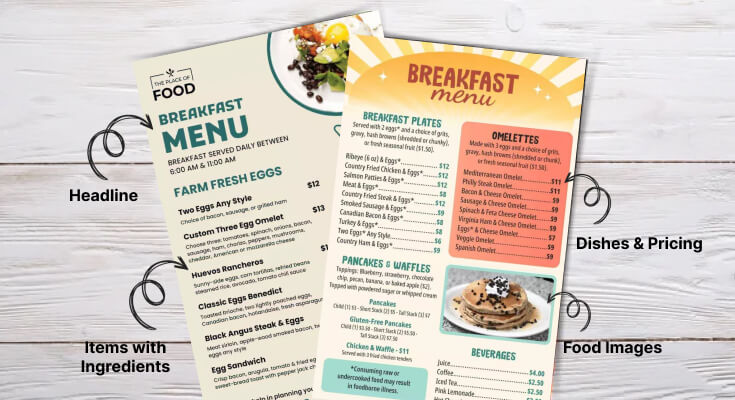
Including the essential elements for breakfast menu design can transform an ordinary dining establishment into a profitable venture that consistently attracts and retains customers. Furthermore, with breakfast being the fastest-growing meal occasion and surging 13.7% in recent years, restaurants must strategically craft menus that attract customers while maximizing profitability.
Moreover, successful breakfast menu design combines psychology, visual appeal, and strategic placement to guide customers toward high-margin items. Consequently, understanding these essential elements will help you create a breakfast menu that not only looks professional but also boosts your bottom line.
What Makes Breakfast Menu Design Effective?
An effective breakfast menu design does more than just list food items—it guides the customer’s choices, creates appetite appeal, and improves the overall dining experience. Whether you’re running a café, hotel, or restaurant, a well-designed breakfast menu can help boost orders, speed up decision-making, and increase sales.
Here are the key components of effective breakfast menu designs:
- Simple and clear layout
- Mouthwatering food description that includes all ingredients
- Highlighting bestsellers and specials
- Appealing to different diets
- Smart use of space for add-ons
- Reflecting Breakfast Timing and Mood
Current Breakfast Trends Shaping Menu Design
The breakfast industry continues to evolve rapidly. Specifically, Americans are choosing more savory breakfast options like tacos with eggs and sausage instead of sweet ones. Moreover, plant-based options have gained tremendous popularity, with customers increasingly selecting almond milk yogurts and vegetarian alternatives.
These trends directly impact how you should structure and design your breakfast menu. Consequently, restaurants must balance traditional favorites with innovative options that appeal to modern diners.
What Are the Core Visual Elements for Effective Breakfast Menu Design?
A good breakfast menu with all essential elements creates a visual experience that makes customers feel hungry, happy, and ready to order. Let’s look at the core visual elements that make a breakfast menu both beautiful and effective.
1. Clear and Organized Layout
A clear and organized layout is one of the most important elements of an effective breakfast menu design. Since breakfast is often a quick meal, customers want to scan the menu and make fast decisions without feeling overwhelmed. A well-structured layout groups similar items together, like eggs, pancakes, healthy options, and beverages, making it easier for customers to find what they want.
Using consistent headings, clean spacing, and logical order helps the eye flow naturally from top to bottom. Too many items crowded on one page can confuse guests and slow down the ordering process. By keeping the design neat and readable, you improve both the customer experience and the speed of service.
Quick tips:
- Divide the menu into clear sections.
- Use enough white space for breathing room.
- Follow a simple top-to-bottom or two-column structure.
2. Typography and Readability
Typography forms the foundation of any successful breakfast menu design. Therefore, choosing the right fonts ensures customers can easily read your offerings without strain. Additionally, clear typography creates a professional appearance that builds trust with your customers.
Consider these typography essentials:
- Primary headings: Use bold, easy-to-read fonts sized 16-20 points
- Item names: Choose fonts that reflect your brand personality while maintaining clarity
- Descriptions: Keep descriptive text between 10-12 points for optimal readability
- Pricing: Make prices visible but not overwhelming
Moreover, avoid using more than two different font families to maintain visual consistency. Similarly, ensure adequate contrast between text and background colors for accessibility.
3. Color Psychology in Breakfast Menu Design
Colors significantly influence customer behavior and appetite. Furthermore, warm colors like orange, yellow, and red stimulate the appetite and create feelings of comfort and energy. Consequently, these colors work particularly well for breakfast menus.
However, balance remains crucial. Additionally, too many bright colors can overwhelm customers and make your menu appear unprofessional. Therefore, use a primary color palette with two to three complementary colors. Additionally, check out what typography and colors work best for menu design, and also how to make a menu that stands out.
4. Layout and Visual Hierarchy
Strategic layout guides customers through your menu systematically. Moreover, effective visual hierarchy ensures customers notice your most profitable items first. Additionally, proper spacing prevents your menu from appearing cluttered or overwhelming.
The “Golden Triangle” concept applies particularly well to breakfast menus. Specifically, customers typically look at the top right, center, and top left areas first. Therefore, place your high-margin breakfast items in these prime locations. Look at some examples of layout menu design to craft and organize the menu perfectly.
5. Appetizing Food Images or Icons
Adding appetizing food images or icons to your breakfast menu can greatly enhance its visual appeal and influence customer choices. People eat with their eyes first, so high-quality photos of popular or signature dishes can instantly grab attention and make the food look irresistible.
These images help customers imagine what the dish will look like, especially if it’s something new or unique. However, it’s important to use only a few well-lit, realistic photos to avoid cluttering the menu.
- Use high-quality photos of your most popular or unique dishes.
- Keep it limited—just 2–4 great photos on the menu. Too many can feel messy.
- Alternatively, use simple food icons or illustrations to represent categories (like a coffee cup, fried egg, or fruit bowl).
6. Balanced White Space
Balanced white space refers to the empty areas between text, images, and sections on your breakfast menu. It may seem like wasted space, but it plays a big role in making your menu easier to read and more visually appealing. When the layout is too crowded, customers can feel overwhelmed or confused. White space helps guide the eyes smoothly across the menu, making each section and item stand out clearly.
How to do it:
- Leave space between menu sections, dish names, and prices.
- Don’t use too many design elements in a small area.
- Let each item “breathe” on the page.
7. Clear Pricing Placement
Clear pricing placement is essential for creating a smooth and stress-free ordering experience. When prices are placed consistently and neatly—usually aligned to the right of each item—customers can quickly compare options without confusion. Messy or scattered pricing can make the menu look disorganized and may cause hesitation or frustration.
- Align all prices to the right of the dish name.
- Keep the font and color for pricing consistent across the menu.
- Consider removing currency symbols (like $) to make people less price-sensitive.
8. Menu Size and Format That Fits the Meal
First of all, you need to understand about menu size, because the size and format of your breakfast menu should match the nature of the meal: quick, light, and often casual. A large, multi-page menu can feel overwhelming in the morning when customers are usually looking for fast choices. Instead, a simple one-page or folded menu is more practical and easier to navigate.
For self-service or grab-and-go settings, a small tabletop or digital menu may be more effective. The goal is to keep it compact, focused, and easy to handle, whether it’s printed or viewed on a screen.
- Use a single-page format if possible, or a folded A4 layout.
- Avoid overly large or booklet-style menus for breakfast.
- For modern digital menu designs, make sure they are mobile-friendly with easy scrolling.
9. Seasonal or Limited-Time Design Elements
Incorporating seasonal or limited‑time design elements helps your breakfast menu stay fresh and engaging by signaling urgency and novelty. Visually separating these dishes—using a subtle banner, badge, or contrasting border draws the eye without overpowering the rest of the layout.
Matching colors or small icons to the season (like a pastel flower for spring specials or a snowflake for winter warmers) instantly tells guests that these items are available only for a short period, encouraging quicker decisions and repeat visits to try new offerings. Keep the treatment consistent but restrained, so the menu remains cohesive and uncluttered.
10. Icons for Dietary Preferences
Including icons for dietary preferences on your breakfast menu is a simple but powerful way to help customers make quick and confident choices. Many people today look for vegetarian, vegan, gluten-free, or dairy-free options, and small icons placed next to dish names make these choices easy to spot without reading every description. This not only improves the customer experience but also shows that your restaurant is thoughtful and inclusive.
Here’s what you can do:
- Use simple, appealing words like fluffy, crispy, fresh, golden, or homemade.
- Keep descriptions short—1–2 lines is enough.
- Add ingredient highlights or preparation methods when needed (e.g., “slow-roasted,” “pan-seared,” “topped with raw honey”).
These are the best elements that every breakfast menu should include. However, you can also explore our library of menu templates, designed for all needs, and help you get ideas for design.
How Should You Structure Your Breakfast Menu Categories?
Most successful breakfast menus organize items into logical categories. Furthermore, familiar categories help customers navigate your offerings quickly. Additionally, clear organization reduces decision fatigue and speeds up ordering.
Consider these essential breakfast categories:
- Egg Dishes: Omelets, scrambles, and benedicts
- Pancakes and Waffles: Sweet breakfast favorites
- Breakfast Sandwiches: Portable options for busy customers
- Healthy Options: Smoothie bowls, yogurt parfaits, and fruit
- Beverages: Coffee, tea, fresh juices, and specialty drinks
Adapting to Modern Dietary Preferences
Today’s customers have diverse dietary needs. Meanwhile, successful restaurants accommodate various preferences without overwhelming their menus. Therefore, indicate vegetarian, vegan, gluten-free, and healthy options throughout your categories.
Additionally, consider creating a dedicated “Healthy Start” or “Plant-Based” section. Furthermore, this approach helps health-conscious customers find suitable options quickly while showcasing your commitment to diverse dietary needs. To make it easier for you to understand how to make a breakfast menu and categorize items, we’ve covered a detailed guide on it here.
What Menu Engineering Techniques Maximize Breakfast Profitability?
Strategic Item Placement
Menu engineering uses psychological principles to guide customer choices. Moreover, the strategic placement of high-margin items significantly impacts profitability. Additionally, understanding how customers read menus helps you optimize item positioning.
Place your most profitable breakfast items in these high-visibility areas:
- Top right corner: Prime real estate for signature dishes
- Center of the menu: Natural focal point for featured items
- First and last positions: Within each category for maximum impact
- Boxed or highlighted sections: Draw attention to special offerings
Pricing Psychology and Presentation
Price presentation affects customer perception and purchasing decisions. Furthermore, avoiding dollar signs can reduce price sensitivity. Additionally, ending prices in 9 or 5 creates psychological anchoring effects.
Consider these pricing strategies:
- Remove dollar signs: Use “12.95” instead of “$12.95”
- Align prices consistently: Don’t create obvious price comparison patterns
- Use decoy pricing: Offer three sizes to make medium options appear valuable
- Bundle smartly: Create breakfast combo deals that increase average order value
Portion and Description Optimization
Writing compelling menu descriptions increases perceived value and justifies pricing. Moreover, descriptive language helps customers imagine the eating experience. Additionally, mentioning preparation methods and ingredients builds trust and appetite appeal.
Effective breakfast descriptions include:
- Cooking methods: “Farm-fresh scrambled eggs”
- Quality indicators: “Locally sourced ingredients”
- Sensory details: “Fluffy buttermilk pancakes”
- Portion cues: “Stack of three” or “Generous portion”
How Do You Incorporate Current Breakfast Trends into Menu Design?
1. Health-Conscious Options
Modern breakfast menus must address growing health consciousness. Furthermore, customers increasingly seek nutritious options that don’t sacrifice taste. Additionally, highlighting healthy choices helps customers make informed decisions.
Successful healthy breakfast menu elements include:
- Superfood ingredients: Chia seeds, quinoa, and acai
- Whole grain options: Oatmeal, whole wheat toast, and brown rice
- Fresh fruit integration: Seasonal berries, tropical fruits, and local produce
- Protein-rich alternatives: Greek yogurt, cottage cheese, and egg whites
2. Plant-Based and Alternative Options
Plant-based breakfast items have become mainstream rather than niche. Moreover, even non-vegetarian customers often choose plant-based options for health or environmental reasons. Therefore, integrate these items throughout your menu rather than isolating them.
Consider these plant-based breakfast trends:
- Alternative milk options: Oat, almond, coconut, and soy varieties
- Meat substitutes: Plant-based sausages, bacon, and breakfast patties
- Dairy-free alternatives: Coconut yogurt, cashew cream, and vegan cheese
- Vegetable-forward dishes: Avocado toast, veggie scrambles, and grain bowls
3. Global Breakfast Flavors
International breakfast items add excitement and differentiation to your menu. Furthermore, customers increasingly seek authentic global flavors. Additionally, fusion breakfast dishes create Instagram-worthy moments that drive social media engagement.
Popular global breakfast trends include:
- Mexican influences: Breakfast tacos, huevos rancheros, and chorizo
- Asian fusion: Breakfast ramen, congee, and Asian-spiced dishes
- Mediterranean options: Shakshuka, Greek yogurt bowls, and olive oil drizzles
- Middle Eastern flavors: Labneh, za’atar, and breakfast flatbreads
What Design Elements Enhance Customer Experience?
Visual Appetite Appeal
High-quality food photography dramatically impacts customer choices. Moreover, professional images increase perceived value and create emotional connections. Additionally, consistent photo styling reinforces your brand identity.
Effective breakfast menu photography includes:
- Natural lighting: Showcase food in appealing, natural conditions
- Consistent styling: Maintain similar angles, props, and color schemes
- Portion accuracy: Ensure photos accurately represent actual serving sizes
- Lifestyle context: Show food in realistic dining situations
Interactive and Digital Elements
Modern breakfast menus increasingly incorporate digital elements. Furthermore, QR codes and mobile-friendly designs accommodate changing customer preferences. Additionally, interactive elements can provide nutritional information and customization options.
Consider these digital enhancements:
- QR code menus: Contactless ordering and easy updates
- Nutritional information: Calorie counts and allergen indicators
- Customization options: Build-your-own breakfast bowls and modifications
- Social media integration: Hashtags and sharing encouragement
Accessibility and Inclusivity
Inclusive menu design ensures all customers can enjoy your breakfast offerings. Moreover, clear allergen labeling and dietary indicators help customers make safe choices. Additionally, accessible design elements accommodate customers with various needs.
Essential accessibility features include:
- Large, readable fonts: Minimum 12-point type for body text
- High contrast colors: Ensure text stands out against backgrounds
- Clear allergen labeling: Comprehensive ingredient and allergy information
- Multiple language options: Accommodate diverse customer bases
How Can You Optimize Breakfast Menu Layout for Maximum Impact?
The Science of Eye Movement
Understanding how customers read menus helps optimize layout effectiveness. Furthermore, research shows predictable eye movement patterns that influence purchasing decisions. Additionally, the strategic placement of items can significantly impact sales.
Key eye movement principles include:
- Z-pattern reading: Customers scan left to right, then diagonally down
- Focal points: Create visual anchors that draw attention
- White space utilization: Prevent overwhelming customers with too much information
- Logical flow: Guide customers through menu sections naturally
Section Organization and Flow
Logical menu organization reduces customer decision time. Moreover, intuitive section flow helps customers find desired items quickly. Additionally, clear section breaks prevent confusion and improve ordering efficiency.
Effective breakfast menu organization follows this pattern:
- Beverages first: Coffee and drinks to start the experience
- Light options: Pastries, yogurt, and quick bites
- Main dishes: Substantial breakfast entrees and specialties
- Sides and additions: Extras and customization options
Whether you want to organize a breakfast, a cozy cafe, or a restaurant menu, we’ve covered the best practices for organizing a menu that you must check out.
Seasonal and Limited-Time Promotions
Seasonal breakfast items create urgency and excitement. Furthermore, limited-time offers encourage repeat visits and the trial of new items. Additionally, seasonal promotions allow menu testing without permanent commitment.
Successful seasonal breakfast strategies include:
- Holiday specials: themed items for major holidays
- Seasonal ingredients: Fresh berries, pumpkin, and seasonal produce
- Weather-appropriate options: Warm comfort foods in winter, light options in summer
- Limited-time positioning: Create scarcity to drive immediate action
What Technology Integration Enhances Modern Breakfast Menus?
1. Digital Menu Boards and Updates
Digital menu boards offer flexibility and real-time updates. Moreover, they reduce printing costs and allow for dynamic pricing. Additionally, digital displays can showcase appetizing visuals and promotional content.
Benefits of digital breakfast menus include:
- Real-time updates: Instant price changes and item availability
- Visual appeal: High-resolution images and dynamic content
- Cost efficiency: Eliminate printing and reprinting expenses
- Promotional flexibility: Easy addition of limited-time offers
2. Mobile Optimization and Ordering
Mobile-friendly breakfast menus accommodate changing customer behaviors. Furthermore, many customers research menus before visiting restaurants. Additionally, mobile ordering capabilities increase convenience and order accuracy.
Mobile optimization essentials include:
- Responsive design: Menus that work on all device sizes
- Touch-friendly navigation: Easy scrolling and selection
- Fast loading times: Optimized images and streamlined content
- Integration capabilities: Connection with ordering and payment systems
3. Data Analytics and Menu Performance
Menu analytics provide valuable insights into customer preferences and item performance. Moreover, data-driven decisions improve profitability and customer satisfaction. Additionally, tracking systems help identify trends and optimization opportunities.
Key metrics to monitor include:
- Item popularity: Best and worst-performing breakfast dishes
- Profit margins: Most and least profitable menu items
- Customer feedback: Reviews and ratings for menu items
- Seasonal patterns: Trending items throughout the year
Frequently Asked Questions
1. Why is menu layout important for breakfast service?
Breakfast is often a fast-paced meal, so customers want to decide quickly. A clean and organized layout allows them to scan the menu easily. Grouping items by category—like eggs, pancakes, and beverages—helps them find what they’re looking for without getting overwhelmed.
2. What type of font should I use on a breakfast menu?
Use simple, clean fonts that are easy to read in the morning light, such as sans-serif fonts like Open Sans or Lato. Avoid script or overly fancy fonts, especially for descriptions. The font size should be large enough so customers don’t have to squint or strain their eyes.
3. What colors work best for a breakfast menu?
Light, warm, and cheerful colors like yellow, soft orange, cream, or pastel tones work well. These colors create a welcoming morning mood. Avoid using dark or harsh colors that might feel too heavy or out of place for breakfast time.
4. Do I need to organize the breakfast menu into categories?
Absolutely. Organizing your menu into categories like Eggs & Omelets, Pancakes & Waffles, Healthy Options, and Beverages makes it easier for customers to browse and choose. Clear headings help guide the eyes and make the menu feel balanced and user-friendly.
5. What format works best for a breakfast menu?
A simple one-page or folded menu works best for breakfast. Customers usually don’t want to flip through multiple pages early in the day. The menu should be light, compact, and easy to handle, whether printed, displayed on a tabletop, or accessed digitally via QR code.
Conclusion
These are some essential elements for breakfast menu design, and they require balancing multiple elements, including visual appeal, customer psychology, operational efficiency, and profitability. Furthermore, successful breakfast menus adapt to changing trends while maintaining core appeal. Additionally, continuous optimization based on data and feedback ensures long-term success.
Remember that your breakfast menu serves as a powerful marketing tool that directly influences customer choices and revenue. Therefore, invest in professional design, strategic organization, and the process of updating a menu. Moreover, focus on creating a menu that reflects your brand while guiding customers toward profitable choices.